LangermannFunction#
- class LangermannFunction(objective: str = 'minimize', modifiers: List[BaseModifier] | None = None, memory: bool = False, collect_data: bool = True, callbacks: Callable | List[Callable] | None = None, catch_errors: Dict[type, float] | None = None)[source]#
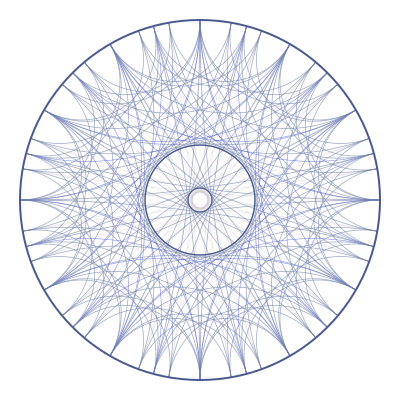
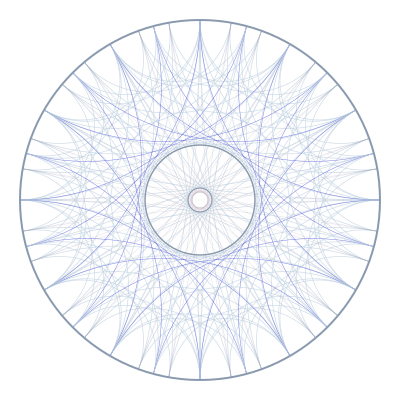
Langermann two-dimensional test function.
A multimodal function with many unevenly distributed local minima.
- Parameters:
Examples
>>> from surfaces.test_functions import LangermannFunction
>>> func = LangermannFunction()
>>> result = func({"x0": 0.0, "x1": 0.0})
- __call__(params: Dict[str, Any] | ndarray | list | tuple | None = None, **kwargs)[source]#
Evaluate the objective function.
- Args:
params: Parameter values as dict, array, list, or tuple **kwargs: Parameters as keyword arguments (only with dict input)
- Returns:
The objective function value
- batch(X: ArrayLike) ArrayLike[source]#
Evaluate multiple parameter sets in a single call.
- Parameters:
X (ArrayLike) – 2D array of shape (n_points, n_dim) where each row is a parameter set.
- Returns:
1D array of shape (n_points,) with evaluation results.
- Return type:
ArrayLike
- Raises:
NotImplementedError – If the function does not implement _batch_objective.
ValueError – If X has wrong number of dimensions or wrong n_dim.
- pure(params: Dict[str, Any] | ndarray | list | tuple | None = None, **kwargs)[source]#
Evaluate the function without modifiers.
Returns the true (deterministic) function value, bypassing any configured modifiers. Does not update search_data, n_evaluations, or callbacks. Ignores memory caching.